AI Security After Black Hat: What Comes Next? with Yitzy
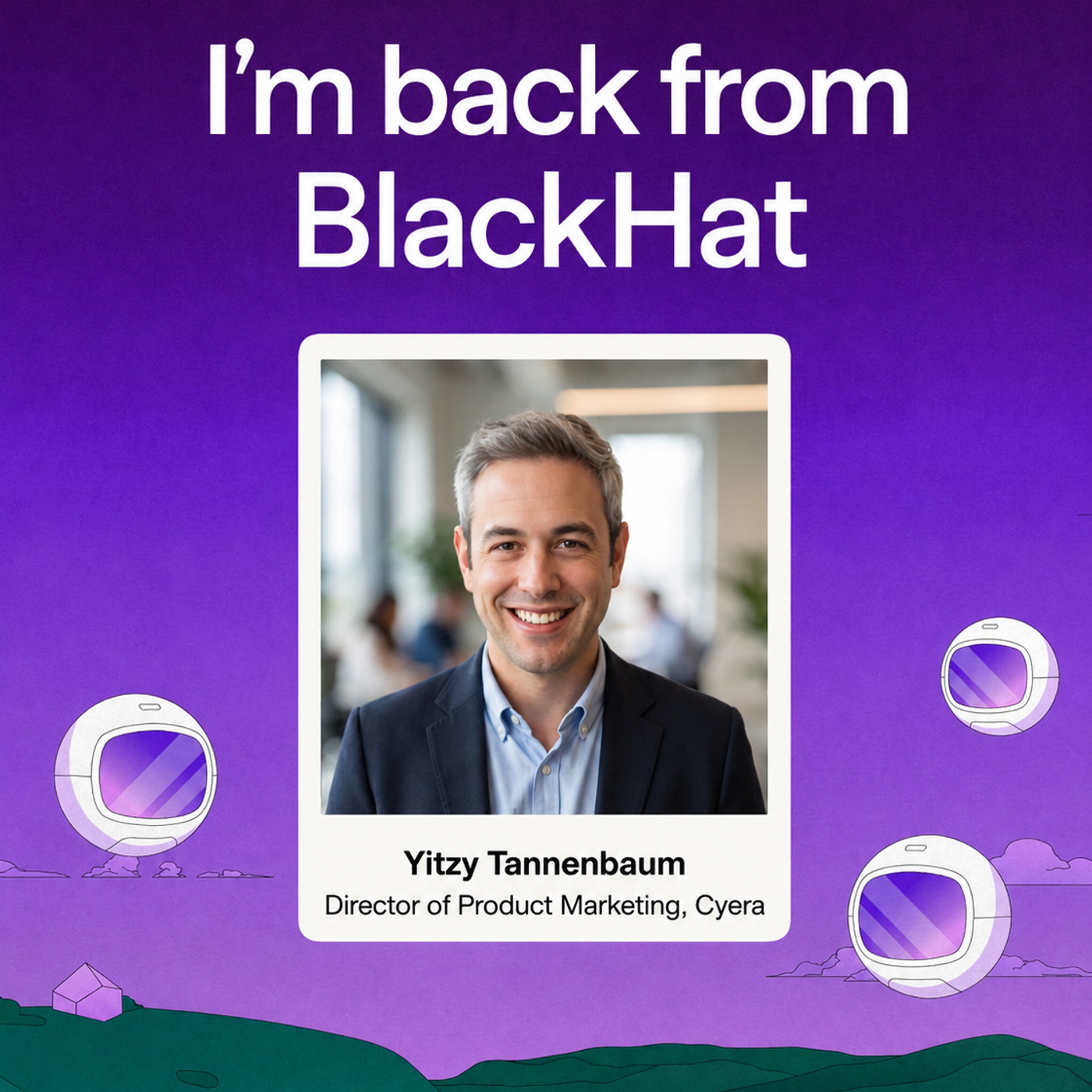
AI is changing cybersecurity at extraordinary speed, but what does that mean for the people building, buying, and securing the next generation of technology?
In this episode, my co-host Yitzy Tannenbaum joins us fresh from Black Hat to unpack the biggest shifts happening across AI security, from the growing convergence of data security and AI security to the race among startups and tech giants to define this emerging market.
We discuss Cyera’s launch of Agent Guardian, why understanding the intent of AI agents is becoming critical, and how rapidly evolving AI capabilities are forcing security teams to rethink traditional approaches.
Yitzy also shares his perspective on the importance of deep domain expertise, the build-versus-buy debate, and why automation won’t eliminate one of cybersecurity’s most valuable assets: human ingenuity.
A wide-ranging conversation about where AI security is today, where it’s heading, and what security leaders should be paying attention to next.
David: Hello everyone and welcome to a new episode of Hot and Tech. And today we're gonna do something a little bit different. you know, my colleague Yitsi's had some new stuff coming up in his life recently, and he just got back from Black Hat. So we thought, why don't we do a session where we hear the latest and greatest of what was going on in Black Hat, and Yitsi will tell you a little bit about what's been going on with him, and yeah. I think this is gonna be really exciting because there's a lot of new things happening. So, Yitsi, what's going on, man?
Yitzy: Yeah, David, you set some high expectations. and David, I I'm thinking it out loud. I don't know if we ever did a really kind of talking between you and I about like our careers and where we've been at, and when we we we kind of star th our first episode touched on it a little bit. but maybe that at some point we should do that as well. I am after a little over three years at Palo Alto Networks, I recently joined Sayara. When I say recently, it's been six months, feels like six years. I joined Sarah. They were the valuation was they raised money at a nine billion dollar valuation. I would say maybe four or five weeks ago, we raised at a twelve billion dollars. We announced the acquisition of OASIS, an identity. Security company for close to a billion dollars. so I'm leading marketing for their AI security part of the business. for those who don't know, Sayaris era, it started out as a data security company. and because they were built in the AI era, so as opposed to the old type of AI companies. They they were able to bring LLM technology into their data classification and understanding. so they quickly became the fastest growing data company, but also s one of the fastest growing cybersecurity companies in the world. and luck hit them twice when AI security and data security are very, very close because AI essentially is a data problem, right? AI is accessing and doing things based on the data it's fed it's fed. So That's a really cool kind of convergence of data security and AI security. And now with this recent acquisition, identity security. so it's been crazy. I've been working extremely long hours. And David, you know this because we have trouble finding times to regard this because I'm usually somewhere I think we did more episodes in hotel rooms than at home. absolutely. And and y you would think that in twenty twenty
David: Either my hotel room or your hotel room. but they got lucky three times. Wait, they got lucky three times. Because they got lucky 'cause they've got you.
Yitzy: I I appreciate that. yeah, you you think in 2026 hotel internet would be better. Right. So so
David: Yeah.
Yitzy: so last week I attended Black Hat under the Sierra kind of group. and you know the the my schedule is broken up into attending sessions, which were super interesting and and Everyone is talking about AI and specifically agent security. ton of customer and analyst meetings. I think our company did all together 200. I wasn't in all of them, but just hearing, you know, what's top of mind for security leaders, AI leaders, was really, really interesting. And then just walking the show floor and get getting that vibe, getting seeing what's going on, seeing what the top technologies are. so a lot condensed in a week. Vegas, as always, is the worst place to be. ever or in August. but it was definitely
David: Hundred and fifteen Fahrenheit, forty four Celsius, something like that.
Yitzy: I I I have a friend who has a sauna at home and he and he told me that he that's that's the temperature he usually configures it to.
David: That's crazy. Yeah. I wasn't I wasn't there this year. I might go back next year, but I can tell you that I was able to set a lot of calls during the week with people who hadn't gone. And I I personally like going there because you know there's a lot of new stuff. That's also it's almost like you know, a meeting place of of the community. And you get to see old friends who you haven't seen all year long and you know, hear about the newest, latest and greatest stuff. I'm interested, you know, like we're hearing a lot about defensive, you know, AI, right? What about offensive in the way of like how are people expanding their pen testing, their red team testing? You know, any any kind of like you know, let's say early testing to prevent or not even need the preventive stuff because they're able to find the holes in what what they're doing.
Yitzy: So so j just to piggyback on your point of of the community and and the kind of it feels like a class reunion a little bit. There was one morning we
David: Ha ha.
Yitzy: we we had like a meeting space the company and just walking from the hotel entrance to the meeting space, it took me probably three hours. Cause you just go and and you bump to someone who you just worked with or you worked with many years ago. You know, some people that you plan to meet and some people that you don't. and most people are people that you don't, you haven't seen in a while. So there there's definitely a fun element. And maybe a s a fun anecdote. I was walking around with a a researcher, one of the really smart peoples in the company. And we knew we know completely different people, but we each bumped into a like our own colleagues, our own peers from our industry. So there's an element of of that. Across from Sierra, the Sarah's. Booth, there was a security. I don't know if you heard of them. They're doing they recently came out of stealth doing automated pen testing. I haven't seen any companies, and and maybe maybe again that's just like the the routes I walked. I know a lot of companies are providing agent red teaming.
David: Mm.
Yitzy: So that's a thing, but I I don't I haven't seen a dedicated company that does only that, but a lot of companies will give that as part of their agent security package. like
David: Interesting.
Yitzy: it's like a dashboard that will always kind of continuously evaluate your agentic kind of footprint and try to give you a a continuous view. From my perspective, David, I don't think companies are there yet. I think companies are way earlier in their journey. Ac actually I I'm I'm I'm here in actually Orlando, Florida at our sales kickoff, our mid-year sales kickoff. And I had an hour and a half yesterday on stage where I started I started my talk talking about The car revolution, right? When cars came out, there were no rules, there were no traffic lights, there were no driver's license, there were no airbags or seatbelts or rules or guardrails, right? It was just you could take your car and drive it everywhere. Today, there's one-way streets and there's speed bumps and there's right, you you have to take a written test, and then you have to take a take a a practical test, right? They're very clear set rules. And I think with similar what cars were probably a hundred years ago, Agents are kind of in that place. It's the wild west. People could do whatever they want. most companies have very little visibility into what agents are running and what they have. Forget about setting rules. some of them think that they could set rules, they usually don't exist. Forget about protection. What happens? We we had this with with one of our customers where this one of the executives had an agent that was supposed to write emails. f it was supposed to write emails, but what it wasn't supposed to send them. It was supposed to write the draft and then the executive would go and and
David: Human human in the middle, right.
Yitzy: Right. The agent started sending the emails on its own.
David: Ha ha ha
Yitzy: Th this is like a real story, like giant fortune fortune two hundred company. You know, th this is a real problem, and I I think we're just trying to start figuring it figure it out. And by the way, old technologies, technologies that you and I know for a very long time, the EDRs, the firewalls, Sassy, they're just not cutting it. It it's like having a hammer trying to fix a watch, right? Like we have tools, but they're not right for the challenges that the agentic era are providing.
David: Interesting. And you and you had a product launch recently, right?
Yitzy: So Sara officially launched their AI security product called Agent Guardian. Took a few years off of my life, but super exciting, a ton of traction because We're lucky enough to, you know, if we're talking about Black Hat, there are lot of companies, many companies that are doing like AI point solutions. We're fortunate to build it on the foundation of a very strong data security understanding. So we have all of that advantage bringing it into just bringing it into Like the a AI security world makes so much sense. So makes it a little easier and and like we already come in with a unique selling point and a unique perspective. so yeah, there's a lot of work ahead of us, but I'm excited to see what we can do.
David: Interesting. You know, I I've seen multiple companies in multiple areas of AI. In fact, full disclosure, I'm actually invested in one or two. and not competing ones, but there one one is the there's one here not too far from where I am, which competes with the one that I invested in, which is actually in Palo Alto. And It's yeah. So it it's really interesting to see the way the market's evolving and I think what we're seeing is that there are a lot of people going out there trying to solve a lot of similar things or using their domain expertise to make things a lot better in the industry that they're working in. So for example, the podcast that we had here, that you know, it was in the financial area, the insurance area, and being able to do things automatically, being able to you know, go in and do compliance and do everything you need to. Th there are things that are being done today that really I think I think what div what separates out between the people or the companies that are going to win and the companies who are more, let's say, they're trying to do a better mousetrap, right? So it's those that take the domain expertise and they couple it with the understanding of what AI can do to make things different. And to make things different and by making them different, they're making them better. As opposed to just saying, if I automate this the system, then I can do it more quickly and maybe save some money. But I'm not actually gonna be coming out with something new. New, exciting, and that will be a game changer. You know what I mean?
Yitzy: Interesting. Yeah, look, every single company that does any type of cybersecurity is now doing AI security. If you are a network security company, if you are an identity security company, if you are an endpoint security company, whatever you did up until now, you are now an AI security company. So each is coming from their own perspective and providing their area of expertise into that domain, right? and I guess the question will be is which foundation is the right foundation? do they have, you know, are they building, I think what you said is spot on. The expertise is is a really important thing here. What they're actually doing, you'll see a lot of these giant companies, it's almost absurd how disconnected a lot of these companies are acquiring companies, right? Cato acquired AIM, Sentinel acquired a company, Palo Alto Networks acquired Protect AI, Veronis acquired Atlas, like like the every every major company has bought a company, but are they integrating those technologies? Are they using their advantage to make that product? way better or is it just living as a startup within the giant company? again, as opposed to other in security industries, AI doesn't have a clear home. There's no like there's no leader in AI security today. There are a lot of players. There's no Messi. There's no Ron Ronaldo. There's no Michael Jordan or again whatever
David: Bruno Fernandez, Man United.
Yitzy: right. But but the right and and I I think one will emerge in twelve months and twenty-four months, one, two, three, the crowd strikes of EGR, right? What checkpoint used to be for firewalls that will come to be. but now it's race it's a race to the to the finish. It's what technologies you have, what customers you're engaging with, how you're building it out, your frame of expertise, the relationships and partnerships you have with the AI vendors and with with channel partners and technology partners. it's a really interesting race and the company that gets to the finish line will do really, really well.
David: So so it's interesting, you know, so we talked in the very beginning about the fact that we haven't gone really too much into our careers. So I I'll I'll mention what I'm doing right now because it also ties in. I'm the CMO of C2A Security. we we provide companies that have embedded systems like anything from automobiles to medical devices to IoT industrial critical infrastructure. They need to comply with many, many different types of regulations. And we provide them a full platform for everything, starting out with software build of materials, understanding what's inside of their products, you know, security by design at the beginning of the production lifecycle, straight through to post-market and everything they need in between to to comply. And somebody said to me, Well, what what about AI? And I said, Well, we're AI driven because we were actually using AI in our platform way before it became even popular and of course it's grown a lot you know since then. and the the other thing is that, you know, we have agents that we use in order to do some of the activities that we provide. But what's the moat? You know, everybody's talking about this proverbial moat. What's gonna keep somebody from coming and copying? And for us it's very simple because we've been working on domain catalogs for the last, you know 10 years and basically we have IP within the within the product, within the platform that very much differentiates us by our ability to take to give contextual intelligence to the teams that have to run after those hundreds and those hundreds and thousands of vulnerabilities and decide which ones are important. So, you know, there are many companies that do it by giving you a list of vulnerabilities. You look at a the CVE rating and you see it's a 9.8 and you say, I need to deal with that one. Well, it's possible that that 9.8, you know, threat can't get anywhere near the things that you're worried about it attacking because there are too many hops to get there. And if you understand the architecture and you understand the context of where that vulnerability is, and you can tie it back into a risk model. Like we do, then you're able to actually put together a system that shows you which vulnerabilities have which risk level. And then you can get rid of, you know, if you have a thousand, you can get rid of 980 of them. And out of the 20 that remain, you know that you have to deal with one, two, five, six, eight, and then the rest, because you're able to tell not only what the CV score is, but you're actually able to tell what that risk is. To your individual product. And that's something that is quite unique in the market. And that is for us, it's our moat. But that said, I'm hearing more and more about companies out there that because of AI, and maybe it has something to do with also their own job security, that they want to be able to develop whatever they need in-house. And this isn't only in the security world, in the cyber world, you know. Somebody said to me a few days ago, why do we need to buy I won't mention the name, but a very popular CRM. When I can develop that in two weeks. Right? Or or
Yitzy: It it's funny it's funny it's funny, David, you're bringing that up 'cause that's the exact example that I heard as well. That specific CRM company that we all know that we're talking about.
David: Ha ha ha ha.
Yitzy: I I was gonna say it, but now now I can because you won't. But but no, but I I I I heard a CIO talking about it. You know, you know, that CRM company we're talking about, licenses can easily cost you over a grand per employee. they were able to replace a lot of it when Building it on their own. Now, yes, it's a lot easier to do it in-house, but sometimes there's expertise and it's it depends on the complexity of the SaaS product you're buying, right? If it's super simple, look, we're replacing our competitive intelligence product, right? Like the ability to aggregate a ton of internal information to analyze it and spit it out, that is something relatively easy to do. Now, if you're
David: It definitely is. Yeah.
Yitzy: N now i if your SAS product i i is doing something like there are you could build anything you want, but it's it's I I think it's almost similar to like a restaurant and cooking at home, right? You c you you can make fried chicken at home, right? Or you could go eat out. You Like a steak. A steak is the easiest thing in the world to make, right? Like they're d you just take it out of the thing, you put it in, and you're done, right? But people still go out. And I I think that's gonna be the same kind of thing. You can make anything you want at home for a fraction of the cost, right? You you can make a pot of pasta or pay a boatload of money for that pot for a small bowl of pasta at a restaurant. and it's just a matter of paying for the quality or doing it in-house and it'll depend on your preferences, your budget, your team, the size of your company, right? If if you have four hundred thousand employees, it may be worth doing a lot of the things in-house. and and then I I'm also expecting David to see a lot of ripoffs and and like kind of you know three, four people in a basement building a pretty solid competitor to these giant companies. I think we're gonna see that as well. And that's why we saw these stocks tank. many of them, right? So many of these SaaS companies have have been struggling in the last year or two.
David: So so at Black Hat, and you know, this is kind of where I was trying to get at. did you see any discussion of that? Because I was at a health, a health and medical device event where we heard discussions about people debating build or buy for, you know, different types of security types of applications. And you know, it reminds me of almost the days when I I don't know if you know if you remember this, but computing was once like there was this notion of client server and architecture, and that all the departments were starting to do their own thing because they got PCs, they got Macs, and they were able to create their own applications, right? And all of a sudden companies realized just how much they're spending on IT, and then guess what? They started outsourcing and the whole cloud thing became a huge, right? And and I'm wondering if we have to get through that. Before people realize, no, I don't want to develop a cybersecurity platform in-house because it means I need to support that. It means I need to keep that up. Or I don't want to create a CRM in-house because it means I same thing. Or the people that are creating these things have two pressures. They have a pressure from the board or from the CEO saying, Hey, what are we doing with AI? They have a pressure on CapEx expenses, so or even Operational expenses, monthly payments to the SaaS companies. Or last but not least, they're a little bit worried about their own job security, and they figure if I start developing this huge application, this huge project, I've got a seat for the next year to two where not only am I going to be in the company, but I'm also going to be developing and learning the best way of creating new things with AI, which
Yitzy: Right.
David: isn't a bad place to be.
Yitzy: It it's not bad place to be, but honestly, David, I I didn't hear that at all at Black Hat. I think people are really scared. I th I think people are, you know, the the challenges that AI and agents present are a game changer for security. And this is not a problem that they sa that they've been solving for 15, 20 years. Right? I feel like a lot of the problems in cloud are different, but kind of follow the same kind of thinking and same kind of problems when the The the problems that agents and AI are presenting really just change the game. And you know, I don't think vendors, even the giants, I don't think they could solve for most of the problems today. They could help. So i i if Palo Alto networks, if CrowdStrike can't solve the problem. you in-house are gonna build a tool and I and many do and try and some do better, some do worse. And look, a a a lot of what we do and a lot of cybersecurity companies have been at do we replace homegrown products. that's a very common thing. So maybe the future holds that all SAS will be you'll wake up in the morning, you'll Hey, I build me a CRM, be a s build me a cybersecurity solution
David: Yeah.
Yitzy: and within the an hour or two you'll have it. but I don't think we're there yet. What was interesting, David, from Black Hat was the resurgence of traditional industries. Like you're getting new companies doing things that happened a long time ago. Like you're getting next gen sim solutions, which it we we saw with Vago. next endpoint. There were I there are probably eight companies doing endpoints that are putting agents on endpoints. they're There are a few companies like Orion and Jazz doing next gen DLP. I saw identity company companies pop up. and it's interesting to see what what they're doing is is saying, hey, this these industries are so old and you've been doing the same thing for so many years with technology evolving, kind of similar to what you guys are doing at C Today, is using that technology to reinvent kind of something that was built so long ago and we're all no no one's looking to innovate, no one's is looking to bring something new. I think they'll they'll have a chance
David: So it's a better it's a better mousetrap without giving well we talked about before, a better mousetrap without really providing a new wow, or or it's or or they're you know or they're providing it at lower cost or more s more technically feat you know, more technical features or
Yitzy: So I I I I I think it's a ladder. I think it's just doing something super old and traditional that hasn't been changed in many or n hasn't been tackled in many years, and we've all been doing the same thing for a very long time. Now they're just doing it so much better and so much smarter and so more efficient, where the outcomes and the business outcomes and the security outcomes are just way better for the end user a relative to the old time products that they had up until now.
David: I th I think it really depends on what area we're talking about. You know, if for example we have someone in house who's an expert in various different AI coding and he's like, hey, I'll build a task manager and he built one really quickly, you know, and I think that's gonna be a challenge, a big challenge to some of the big companies out there, you know. the cybersecurity world's a bit different because cybersecurity I think it really depends on the understanding, that domain expertise. It's not like, you know, okay, a task manager you can see pretty And I don't want to belittle any task managers, God forbid, but you definitely, you know, there are some things that are very much straightforward, and there are some things that really require domain expertise. And also with us in C2A, also with what you guys are doing, and many of the other cyber companies, also the startups, There's mate security, aim security, you know, these guys, I met them early on, incredible. I mean, I I met these guys, I'm like, wow. you know, amazing stuff. And you know, it's it's something where they get it and they understand it and they understand how to build it and what needs to be built because this is what they've been doing for their lives, you know, in the last fifth ten, fifteen years, whatever. you know, building up into AI. So I I think that there's gonna be if I use Gottner terms, there'll there'll be a disillusionment period where people are gonna try to do things in-house and like you said they'll get to a point where They have everything automated, or so they think. They have human in the middle, or so they think, and all of a sudden an email is gonna shoot out and cause some grief, or something will happen with the product or the system that they built, and they have no idea why. And when they ask, you know, the AI module, it's gonna basically say, Well, you developed it this way. Well, I didn't really develop it. Something happened along the way that changed it. and that they're gonna be crawling back looking for solutions from people who have that domain expertise.
Yitzy: David, at some point we should have a similar conversation about analyst relations. I'm sure you have you you you
David: Ha!
Yitzy: have an interesting perspective there. But but but back to your point, another thing that you maybe take
David: Don't forget I'm under a lifelong NDA from Gottner, so I spent I
Yitzy: I did not know that. wow. So
David: spent a little bit of my career at the Gottner organization. And yeah, they had a pretty nasty NDA.
Yitzy: But but d David, going back to your point y about domain expertise, I think you're you're spot on. But another thing you probably didn't consider is the speed that AI is evolving, right? If you look at a company like Anthropic, right, every two, three weeks, a month, they have something completely new. And if you're building this in-house, like are you keeping up with like whatever. They recently announced that they're moving to the cloud, right? So if you were just protecting endpoints, are you now completely shifting your entire security program? You know. you need a company and and like you need you do need experts to be able to keep up with the speed of how the how this is going and where this is going. It was funny. As I mentioned I'm I'm here at our sales kickoff and there are a few developers here and you would see them like in the hotel la lounge or lobby just like you know
David: Coding away.
Yitzy: coating away and literally some of the features that came out just happened in the hotel lobby because that's how you have to roll today. The the you can't plan a product for eight months and push it out. It just it that's not the the world will change, the technology will change a hundred and eighty degrees in six months. So it needs to be quick, it needs to be fast, it needs those expertise that you were mentioning. and I think that's why there's no clear winner just yet is because the the race is on and we're racing between ourselves, but we're also racing the technology.
David: Okay, so for some fun stuff, what was the best session that you went to in Black Hat and why?
Yitzy: Ooh, interesting. So there were there were there are a few good ones. I very much enjoyed a Forester session by Jeff Pollard and Heidi Shea on intent, right? Understanding the intent of an agent. Why was this agent created? What's its intended purpose? And is it drifting from that purpose? And is that drift positive or negative? It was a framework of understanding that an agent Can veer from its course. Sometimes that's negative, but sometimes I want it to kind of go a little beyond the scope of where I wanted it. So th they set a very interesting framework around the idea of intent. And I see vendors kind of adopting. that and I think that's gonna be a big piece of how we look at AI. 'cause we're gonna wanna understand and set guardrails of what's good and what's bad. And I don't think we have a clear understanding of what that looks like. Or you know, sometimes I want my AI to to go a little beyond or to search beyond or to poke around a little bit more than my what I had in mind. But then on the other hand, I don't want it to gear too far or drift too far. How do I recognize that? How do I identify that? And how do I stop that? So it it it got me thinking a lot about, you know, what guardrails looks like and and Again, I don't think we're there yet. I think these these ideas, these frameworks are just putting into being put into place as the technology evolves and as autonomous agents become. David, how long ago like did coding agents exist? They've been a big thing, maybe for six months? Maybe. And bring generous. So th that was an intri like that that had me thinking a lot after like I I remember like It 'cause it's almost philosophical, right? Like trying to understand where we draw the line, w like w good versus bad in that world.
David: Right. Interesting. Okay. The the person you met at Black Hat who you didn't expect to meet, who was let's say all right, yitsi, shout out to 'cause it was amazing seeing them there. He or she or other
Yitzy: God. Dude, th there's so many people. Like I I feel I'm trying to think. I I I I'll have to group a loop loop this into as I mentioned, I I left Palo Alto around around six months ago and I didn't I didn't expect to see that many folks. Some of them I planned to meet, but i it it was nice just to see the people. Some a good chunk of them are no longer there and they're all in different companies doing different things. but I work I I work with so many great people and my four my former manager, Josh Casta, Dan Flarity, the the partnership people, the the events people, the f my former marketing folks, Parker Crook, yeah, who else? yeah, it it was very
David: And everybody else you didn't remember to name, who was probably thinking, Why didn't he say talk about me?
Yitzy: Peter Havens. Yeah, we we
David: Yeah.
Yitzy: we could be here for a while. It just dude, there's just not a lot of time. You're like, hey, I'm gonna grab you later, and then just like we don't bump into each other again. But I probably set up at least four or five calls with old friends. You're like, hey, we should really catch up. You know what's interesting? I did bump into L'Vee Fredman, who I do do you know Lavey LaVee is one of the founders of Upwind. I
David: Mm.
Yitzy: haven't I worked with him in 2020. 12 at IBM. we were both very, very young, and just to see kind of where he's gone and this like this is his second company. we actually had like a happy hour together with them. It it really is amazing to see, like, you know, people, my peers doing extremely well and starting. there were there were people I worked with at Syrah who went off to do their own thing, and there was just the three of them. They told me that they just raised 10 mil. It it's just exciting to see r you know, people you admire, people you look up to, people who are really, really smart, who's just David, they've been they're crushing it and it it it's so heartwarming to see th them kind of live up to what they love doing and looking to make the world a better place.
David: Very cool, very cool. What was the best party?
Yitzy: parties. It's it's funny, like I I really did my best to not lose my voice.
David: Yeah.
Yitzy: but everything is so loud. I I think David, what what's the age that you hit when just everything is too loud?
David: man.
Yitzy: Mm-hmm.
David: I think yeah. Yeah.
Yitzy: It's it's it's probably my age. But Sarah Sarah had a very cool party with we we had Ludacris who came. I
David: But but Wow. Okay.
Yitzy: didn't know I was that big of a Ludacris fan, but being there
David: Ha.
Yitzy: with my colleagues and David, we've been working so hard and and just being able to let loose and and and just like For a for a split second, forget where you are. You're in the hottest city in the world. Kind of the the worst city and one would argue one of the worst cities of the world. but but but you're you're you're there and it's and and you you could just have a good time and laugh and dance and and forget that.
David: Work hard, play hard. That still is the you know still drives the high tech world.
Yitzy: Yeah, but but if we if we spoke about the speed, like being in this industry now, I haven't been doing it as long as you, but at this point I've been doing it for a hot second. the the speed it does require like l very long days. So so it it it was nice to to lose my voice yet again. and yeah, yeah, you know, forget about jet lag for a hot second and and yeah, party it up.
David: I I have really mixed feelings about the industry right now because I'm thinking, okay, you know, I'll be around tech for a while still. I'm not going anywhere. But like you said, things are moving so fast and you know, in some ways you almost want things to be like they used to be, where you could actually make a plan and keep it for a year, versus in two months changing things because things are moving so quickly that you need to change things or you know I mean, just the other day I was thinking, okay, so I need another person to do X. Right. I said, okay, so tomorrow morning I'm gonna build that person. And I did, and I built the person. And it took me a couple of hours to really fine tune what I wanted. But now I have the basis automated for that person. You know, and that's a little scary. but from a productivity point of view, it's amazing. And you know, it's it's somebody would say, okay, well, you don't really have the creativity, you don't have the you know, that intuition, you know, built in. And I'm thinking that's not a hundred percent true because you can go out and ask your AI, whatever platform you're using, to go out and find the voice of whatever person or industry you're looking for, and you can build that into the creativity. So I would argue that if you do it correctly, you can you know, do a lot of stuff. and you know, people people who say that, by the way, they tend to be because they worry about their jobs. But I think there there's a lot of stuff that we are doing and we can continue doing. And I think that you know, that's that's a big plus. On the other hand, it's moving so quickly, I have no idea what I'm leaving to my next generation and their kids and, you know, so on and so forth. It's it's gonna be in a way it's a little bit scary. But it's also a tremendous opportunity, tremendous opportunity.
Yitzy: David, but but you've been doing this long enough that we've been automating things for a very long time. I'm sure that there are people that you you hired te 20 years ago that you no longer had to because you found automation, right? Yes, the hockey stick here is growing exponential like what the yes,
David: Yeah.
Yitzy: automate. But still, like we you you replaced people with applications and and programs for years, right? I think the the the the need for humans exists. Just we're expected to do things if your job is mundane. I I I I heard an interesting podcast where someone said, if you could explain what you do in words, you'll you're replaceable. Right. So if you're a bookkeeper and you manage the books, you're replaceable. If you can explain in words, if your job is so diverse that you're doing 12 different things and you're program managing and You're bringing in ideas, you're being creative. That those are the people that will probably take longer to replace. I'm not worried as others are that they're like everyone's gonna be replaced and it's just gonna be a world where I I wish the world will be run by machines and I could sit by the beach or go bowling.
David: Ha ha ha.
Yitzy: but I I I think Human ingenuity, creativity, kind of out of the box thinking, a little bit of craziness, human interaction, that's something that will last. It's the boring, the mundane, the tactics, the execution, those are the places that will be replaced. So yeah, like you have to be learning. You have to learn how to orchestrate these tools, how to build the things out, how to use the tools to your advantage, right? If you're still walking around with a Hammer when there's a electric drill, like you need to evolve with the tools. You need to know how to use the tools. If you're trying to force your old tools in new age, you're doing something wrong. But but I I do think that humans are still needed because we bring something that at least today the machines can't. We bring that connection, we bring the ideas, we bring the creativity, we bring the collaboration. Yeah.
David: We bring the emotion. Yep, I agree with you a hundred percent. Cool. Well, I think on that note, I'll tell you one last thing about my not going to Black Hat this year. I I didn't have a case of FOMO, but I did have a case of I really like going and meeting up with old friends, and and that's something I miss a little bit. I think a lot of the stuff in a lot of the sessions at Black Hat will be recorded, will be posted, will be shared by the companies. But those those l like you said, those meeting those people and taking the three hours to get from place to place, that's something I I definitely missed out on this year. And hopefully next year we'll be back in in Vegas in a hundred and twenty degrees, hundred and fifteen degrees, thinking, What am I doing here? But
Yitzy: global global warming is definitely a thing. And s since you asked me the question, like it twelve other names popped up. But yeah, i i it was definitely a good experience. really interesting to see. I thought every single company would be AI security and I I was surprised to see those you know, kind of more traditional industries k getting this this resurgence and coming back, newer, better, smarter with the smaller companies coming out there, the identities, the the endpoints, the DLPs, like industries that I thought no one would t ever touch again. so so the industry is definitely kicking beyond just AI security. AI security is gonna be the talk of the town for the everything is gonna be AI security moving forward. It'll be interesting to see what that would look like here.
David: By the way, last question, any quantum?
Yitzy: I'm sure I didn't see it. I aga and again, maybe because it's not as much my domain. Right.
David: Not your focus, right?
Yitzy: So I I'm and then I'm sure there were sessions I did I that I didn't attend. But even walking the floor, I don't remember quantum secur like dedicated quantum security being a main topic. But again, it it may just be a like my point of view versus I'm sh like I'm sure it existed. I just don't remember really me personally double clicking on it.
David: Got it. Yitsi Tannenbaum. It's been a great show and thank you for being my co-host on Hott and Tech. And thank you for being with us today and giving us you know, your own personal background and also telling us what happened at Black Hat.
Yitzy: We should do more of these. Thanks, David.
David: All